



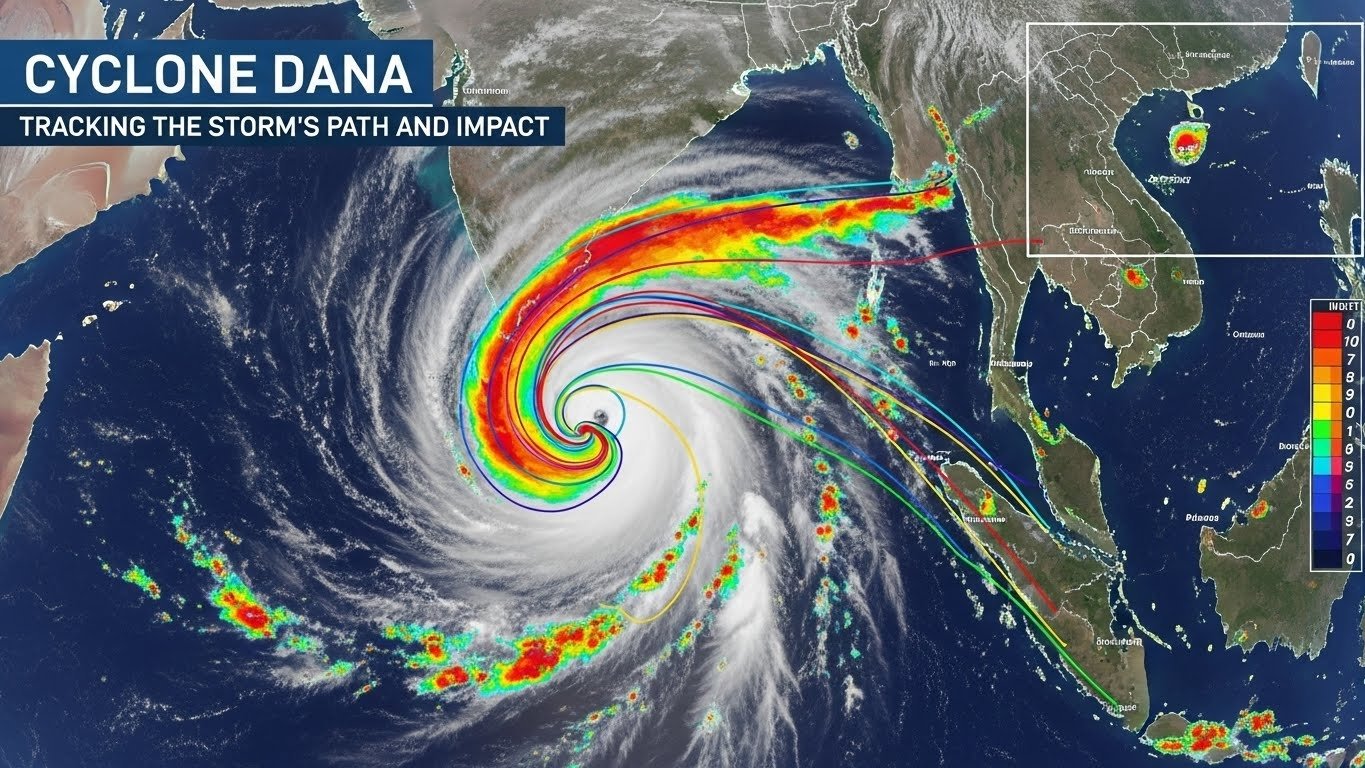
The phenomenon of tropical cyclones in the North Indian Ocean remains one of the most significant meteorological challenges for the Indian subcontinent. In late October 2024, the region faced a formidable threat in the form of Cyclone Dana. This severe cyclonic storm, which originated in the Bay of Bengal, tested the resilience of coastal communities, the precision of weather forecasting models, and the effectiveness of large-scale disaster management protocols. Named by Qatar, with the word signifying “generosity” or “a perfect pearl” in Arabic, the storm brought a complex mix of heavy precipitation, high-velocity winds, and tidal surges to the states of Odisha and West Bengal.
1. The Genesis of the Storm
The story of Cyclone Dana began in the third week of October 2024. Meteorological indicators first identified a low-pressure area over the East-central Bay of Bengal on October 22. Fueled by sea surface temperatures reaching as high as 30°C, the system quickly gained energy. Within twenty-four hours, the India Meteorological Department (IMD) upgraded the system to a depression and subsequently to a deep depression.
You Might Also Like: Mongibello etna
By October 23, the system intensified into a cyclonic storm and was officially designated as Cyclone Dana. This rapid intensification is a characteristic often seen in post-monsoon storms in the Bay of Bengal, where the combination of warm water and low vertical wind shear creates an ideal “engine” for cyclonic growth. Unlike some storms that linger at sea, this system followed a steady West-Northwest trajectory, aiming directly for the northern coast of Odisha.
2. A Masterclass in Disaster Preparedness
One of the most remarkable aspects of the Cyclone Dana event was the sheer scale of the preventative measures taken by the Indian government. Lessons learned from past tragedies, such as the 1999 Super Cyclone and Phailin, have transformed Odisha into a global model for disaster management.
The Zero-Casualty Target
Odisha’s Chief Minister set a clear and ambitious “zero-casualty” target. To achieve this, the state administration launched a massive evacuation drive that saw over 600,000 people moved to safe shelters within 48 hours. These shelters, specifically designed to withstand high-velocity winds and storm surges, were equipped with food, water, and medical supplies.
Strategic Deployment of Forces
The response was not limited to local administration. A multi-agency coordination effort was launched, involving:
- NDRF: The National Disaster Response Force deployed 25 teams across vulnerable districts.
- ODRAF: The Odisha Disaster Rapid Action Force mobilized 51 teams for immediate rescue operations.
- Fire Services: Over 200 fire service units were placed on standby to clear uprooted trees and restore road connectivity.
The logistics of Cyclone Dana preparation also extended to the health sector. In a particularly compassionate move, over 4,000 pregnant women were shifted to “Maa Gruhas” (maternity waiting homes) and hospitals to ensure they were safe during the height of the storm.
3. The Science of the Landfall
As Cyclone Dana approached the coast, the landfall process began on the night of October 24, 2024, and continued into the early hours of October 25. The storm officially crossed the coast between Bhitarkanika National Park and Dhamra Port in the Kendrapara and Bhadrak districts of Odisha.
Wind Speeds and Pressure
At the time of landfall, the storm maintained sustained wind speeds of 100 to 110 kmph, with gusts reaching up to 120 kmph. The minimum central pressure was recorded at 986 mb. While these speeds were lower than some of the most historic super-cyclones, they were more than enough to uproot thousands of trees, damage power infrastructure, and destroy thatched “kutcha” houses.
The Protective Shield of Mangroves
A significant observation during the landfall of Cyclone Dana was the role played by the Bhitarkanika mangroves. Environmentalists and researchers noted that the dense mangrove forest acted as a natural windbreaker and reduced the height of the storm surge. This highlights the critical importance of coastal ecosystem preservation as a first line of defense against climate-induced disasters.
4. Widespread Impact Across the Coast
The reach of Cyclone Dana extended far beyond its immediate landfall point. While Odisha bore the brunt of the wind, West Bengal experienced extreme precipitation.
Rainfall and Flooding
The storm brought “extremely heavy” rainfall to districts like Balasore, Mayurbhanj, and Bhadrak in Odisha, and East Medinipur in West Bengal. In some areas, rainfall exceeded 150 mm in a single 24-hour period, leading to localized flooding and waterlogging. Kolkata, the capital of West Bengal, faced disrupted traffic and waterlogged streets, causing the suspension of flight and train operations for several hours.
Agricultural Devastation
Perhaps the most lasting scar left by Cyclone Dana was on the agricultural sector. The timing of the storm was particularly cruel, as it coincided with the standing rice crop (Kharif) being near maturity. According to initial assessments, over 180,000 hectares of cropland were inundated or flattened. For many small-scale farmers, this represented the loss of their primary livelihood for the year.
5. Human Stories and Local Heroes
Behind the data and satellite imagery of Cyclone Dana were millions of individual stories of bravery and community spirit. One story that captured the nation’s heart involved an ASHA worker in Odisha who carried an elderly, ailing woman on her back for several kilometers to ensure she reached a cyclone shelter before the winds picked up.
In West Bengal, local community groups dismantled festive “pandals” (temporary structures) prematurely to prevent them from becoming airborne hazards during the storm. This proactive community involvement was a key reason why the loss of life remained remarkably low despite the storm’s intensity.
6. Economic Consequences and Reconstruction
The financial toll of Cyclone Dana was significant. Preliminary reports estimated the total damages in Odisha alone to be around ₹616 crore (approximately $73 million). This figure includes:
- Infrastructure: Over 120 electric poles and several mobile towers were damaged, leading to temporary communication blackouts.
- Housing: More than 16,000 homes sustained varying degrees of damage, ranging from roof loss to complete structural failure.
- Power Supply: While 90% of power was restored within three days, the initial blackout affected millions of households.
The government of West Bengal also reported significant embankment failures, which allowed saline water to enter agricultural fields, potentially affecting soil fertility for future seasons.
7. The Role of Technology and Forecasting
The management of Cyclone Dana was a victory for modern technology. The IMD utilized advanced satellite imagery, Doppler weather radars, and ocean buoys to track the storm’s every move. While there were some initial discrepancies in various global models (such as GFS and ECMWF) regarding the exact landfall point, the IMD’s narrowed “cone of uncertainty” allowed the administration to focus resources where they were needed most.
Furthermore, “Cell on Wheels” (CoWs) and intra-circle roaming for telecom services ensured that even when specific towers went down, emergency communication remained active. This digital infrastructure is as vital as physical shelters in modern disaster response.
8. Lessons for the Future
Every storm provides a lesson, and Cyclone Dana is no exception. It served as a reminder of the following:
- Investment in Nature: Preserving mangroves and coastal wetlands is not just an environmental goal; it is a life-saving infrastructure project.
- Granular Data: There is a continued need for better sub-surface ocean temperature monitoring in the Bay of Bengal to improve the accuracy of rapid intensification forecasts.
- Climate Change Reality: As the ocean continues to warm, the frequency of severe storms is likely to increase. Resilience must be built into the very design of our coastal cities and villages.
The aftermath of Cyclone Dana saw the swift deployment of restoration teams. Within days, roads were cleared, schools reopened, and the process of rehousing displaced families began. While the wind has subsided, the work of building a more “cyclone-proof” future continues.
9. Conclusion
Cyclone Dana was a significant event in the 2024 North Indian Ocean cyclone season. It was a test of will, a test of science, and a test of community. While the storm caused undeniable economic and agricultural hardship. The remarkably low casualty rate stands as a testament to what is possible when government and citizens work in unison. As we move forward, the memory of Cyclone Dana will serve as both a warning and a blueprint—a warning of the power of nature and a blueprint for the power of preparation.
The inhabitants of the Bay of Bengal coastline have lived with the threat of the sea for generations. With each storm like Cyclone Dana, they refine their defenses and strengthen their resolve, ensuring that while the winds may blow, the spirit of the people remains unshaken.