



Choosing a location for your business in the UAE is a bit like choosing a spouse: it’s incredibly exciting at the start, but if you pick the wrong one, the “divorce” is going to be complicated, expensive, and emotionally draining.
With over 40 free zones scattered across the seven emirates, the “paradox of choice” is real. Most entrepreneurs walk into this landscape thinking a free zone is just a free zone, a tax-free bubble where you get a residency visa. But that’s a misconception that costs thousands of dollars in restructuring fees later. Specifically, the debate often boils down to a heavyweight battle: ADGM (Abu Dhabi Global Market) vs. Everywhere Else.
Choosing between the prestigious, common-law environment of Abu Dhabi or the high-speed, low-cost hubs of Dubai and the Northern Emirates isn’t just a matter of price; it’s a matter of destiny. This guide will help you strip away the marketing fluff and choose the right jurisdiction based on where you want your business to be in five years, not just five days.
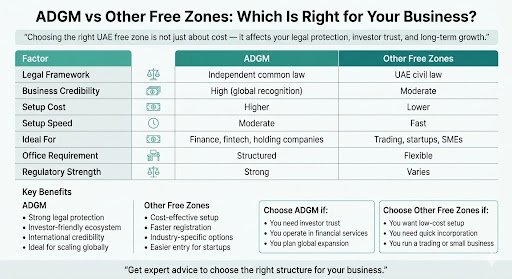
ADGM or Other Free Zones?
If you’re looking for the “TL;DR” version, here it is:
- Choose ADGM if you are an investment firm, a holding company, a high-growth fintech startup, or a family office that requires an English Common Law legal framework and high international credibility.
- Choose Other Free Zones (like IFZA, DMCC, or Meydan) if you are a consultant, an e-commerce startup, or a small-to-medium enterprise (SME) looking for a fast, cost-effective setup with minimal regulatory red tape.
The right choice depends on your budget, your business activity, your banking requirements, and whether you plan to raise venture capital.
What is ADGM?
Abu Dhabi Global Market (ADGM) isn’t just a place to park a desk; it’s an award-winning International Financial Centre (IFC) located on Al Maryah and Al Reem Islands.
Key Features
What sets an ADGM company setup is its legal DNA. While the rest of the UAE operates under a Civil Law system (based on Egyptian and French models), ADGM operates under English Common Law.
- Independent Jurisdiction: It has its own courts, its own financial regulator (FSRA), and its own registration authority.
- Predictability: For international investors, English Common Law is the gold standard for contracts, shareholdings, and dispute resolution.
Who it’s designed for:
ADGM is the playground for the “big fish.” It is the preferred home for institutional investors, VC funds, Fintech pioneers, and Complex Holding Structures. If you want to issue different classes of shares or set up an Employee Stock Option Plan (ESOP), ADGM makes it seamless.
What are Other Free Zones?
When we talk about “other free zones,” we’re referring to hubs like DMCC (Dubai), IFZA (Fujairah), RAKEZ (Ras Al Khaimah), and Meydan. These are the engines of the UAE’s SME economy.
General Characteristics
- Lower Barrier to Entry: You can often get a license for a fraction of the cost of an ADGM setup.
- Speed: Some zones, like IFZA or SHAMS, can issue a license in as little as 48 hours without you ever stepping foot in the country.
- Specialization: DMCC is king for commodities and gold; Dubai Internet City is the hub for tech; SHAMS (Sharjah) is great for creative and media professionals.
ADGM vs. Other Free Zones: The Core Comparison
| Factor | ADGM | Other Free Zones |
| Legal System | English Common Law | UAE Civil Law |
| Setup Cost | High ($15k – $20k+ Year 1) | Low – Medium ($3k – $8k Year 1) |
| Setup Time | Moderate (2–4 weeks) | Fast (2–7 days) |
| Best For | Investors, Holding Cos, Fintech | Consultants, E-commerce, SMEs |
| Banking | High Credibility (Easier Approval) | Mixed (Can be difficult for some) |
| Office Requirement | Structured (Physical or Flexi) | Highly Flexible (Virtual/Co-working) |
| Reputation | Premium / Institutional | Functional / SME-focused |
Who Should Choose ADGM?
An ADGM company set up is a strategic investment. You don’t do it because it’s easy; you do it because it’s robust.
- Holding Companies: If you own assets globally and want to ring-fence them under a jurisdiction that global courts recognize and respect.
- Family Offices: For managing multi-generational wealth with sophisticated trust and foundation structures.
- Investment & Fund Management: If you are managing third-party capital, the FSRA regulatory framework in ADGM provides the oversight that LPs (Limited Partners) demand.
- Fintech Startups: ADGM’s “RegLab” is one of the most advanced sandboxes in the world for testing blockchain and crypto-financial services.
Why? Because when you go to a VC in London or New York and say your parent company is in ADGM, they don’t blink. They understand the legal protections.
Who Should NOT Choose ADGM?
Here is the honest truth that many consultants won’t tell you: ADGM is overkill for many.
- Low-Budget Startups: If your total startup capital is $20,000, you shouldn’t spend $18,000 of it on a license.
- Solo Freelancers: A copywriter or a graphic designer doesn’t need English Common Law courts to protect their “assets.” A simpler, cheaper zone like Meydan or SHAMS is perfectly sufficient.
- Standard Service Businesses: If you’re running a small marketing agency or a local recruitment firm, the compliance burden of ADGM (audits, data protection filings) will likely feel like an unnecessary weight.
Best Free Zones Based on Use Case
Not all zones are created equal. Here is our “Cheat Sheet” for 2026:
- Best for Startups (Low Cost): IFZA or RAKEZ. They offer excellent “package” deals including visas.
- Best for Consultants: Meydan Free Zone. It’s located in Dubai, has a prestigious address, and is very cost-effective.
- Best for E-commerce: SHAMS or DMCC. DMCC is better if you need physical warehousing; SHAMS is better for dropshipping.
- Best for Holding Companies: ADGM, hands down.
- Best for Fintech: ADGM or DIFC (Dubai International Financial Centre). Both are elite, though ADGM is often praised for being more “digital-first.”
Real Cost Comparison: Transparency Matters
Let’s talk numbers. Many people get “fooled” by the initial setup price and forget about the Year 2 reality.
ADGM Costs
- Year 1: Between $15,000 and $22,000 (including registration, license, and a basic flexi-desk).
- Recurring: You must account for Annual Audits, Data Protection Renewals, and Corporate Tax Compliance.
Other Free Zones
- Year 1: Between $3,500 and $7,000 for a zero-visa or one-visa package.
- Hidden Costs: Watch out for “Visa Allocation” fees and mandatory “E-channel” deposits that some cheaper zones don’t mention upfront.
Banking Reality: The Credibility Gap
In the UAE, getting your license is 10% of the battle. Getting a bank account is the other 90%.
The jurisdiction you choose drastically affects your banking success. Banks in the UAE (and globally) perform “Risk Categorization.”
- ADGM/DIFC: High credibility. Banks view these entities as “vetted” because of the strict KYC and compliance standards of the regulators.
- “Budget” Free Zones: Certain northern emirate free zones are flagged as “higher risk” by some Tier-1 banks. This doesn’t mean you won’t get an account, but you might be forced to use digital-only banks or wait 3–4 months for approval.
Key Insight: If your business model involves high-volume international transfers, an ADGM company set up might save you months of banking headaches.
Common Mistakes Investors Make
- Choosing the Cheapest Option: “License-shopping” solely on price often leads to choosing a zone that isn’t on the “approved list” of the bank you want to use.
- Ignoring the “Substance” Rules: You cannot just have a paper company. To qualify for the UAE’s 0% or 9% corporate tax benefits, you must show “Economic Substance.”
- Selecting the Wrong Activity: If you select “Consultancy” but actually do “Financial Advice,” you risk heavy fines and license revocation.
- Trusting “All-Inclusive” Packages: Often, these packages exclude mandatory costs like the Emirates ID, medical tests, and the Establishment Card.
Hidden Limitations of Free Zones
It’s important to remember that a Free Zone is technically “offshore” in relation to the UAE Mainland.
- Trading Restrictions: You cannot directly sell physical goods to a customer in Abu Dhabi or Dubai mainland from a free zone license without a distributor or a “Dual License.”
- Government Tenders: Most UAE government contracts require a “Mainland” (DED) license. If your goal is to win government work, a free zone might be the wrong choice entirely.
Step-by-Step: How to Choose the Right Free Zone
Don’t let the shiny brochures distract you. Follow this framework:
- Define Your Activity: Be hyperspecific. Are you trading, consulting, or holding assets?
- Set Your 3-Year Budget: Can you afford $10,000 a year for compliance? If not, skip the premium zones.
- Check Your Banking Needs: Will you be dealing with high-risk jurisdictions? If so, you need a premium zone for credibility.
- Assess Your Exit Strategy: Do you want to sell the company or raise VC? Investors want ADGM/DIFC.
The Decision Framework
- Low Cost + Fast Setup ➔ IFZA / Meydan
- Strong Reputation + Investor Friendly ➔ ADGM
- E-commerce + Physical Goods ➔ DMCC
- Creative / Media ➔ SHAMS
ADGM Company Set Up:
If you’ve decided that ADGM is the path for you, the process is a bit more formal than other zones:
- Entity Structure: Decide between a Private Company, an SPV, or a Foundation.
- Initial Application: Submit your business plan and UBO (Ultimate Beneficial Owner) details for “In-Principle Approval.”
- Documentation: Provide attested documents if the shareholder is a foreign corporate entity.
- Final Licensing: Sign the lease (Flexi or Physical) and pay the final fees.
How Dubai Business & Tax Advisors Help
Navigating the UAE’s 40+ free zones is a full-time job. We see founders every week who chose a “cheap” zone and are now stuck because they can’t open a bank account or their investors won’t touch the structure.
At Dubai Business & Tax Advisors, we don’t just “sell licenses.” We provide:
- Jurisdiction Consulting: We analyze your business model and match you with the zone that actually fits.
- End-to-End Set Up: We handle everything from the initial name reservation to the final Emirates ID in your hand.
- Banking Assistance: We have direct relationships with relationship managers at Tier-1 UAE banks to expedite your application.
- Tax Compliance: We ensure your structure is optimized for the new UAE Corporate Tax laws.
Frequently Asked Questions
- What’s the main difference between ADGM and other UAE free zones like DIFC or DMCC?
ADGM operates under English Common Law and specializes in financial services and high-value commercial activities, similar to DIFC. However, DMCC, JAFZA, and most other free zones focus on trading, logistics, and commercial activities under UAE civil law. ADGM and DIFC offer stronger legal frameworks for international investors, while zones like DMCC are more cost-effective for trading and distribution businesses.
- Is ADGM more expensive than other free zones?
Yes, generally. ADGM has higher setup costs, license fees, and office rental rates compared to free zones like RAKEZ, SHAMS, or Ajman Free Zone. You’ll pay premium prices for premium infrastructure, legal certainty, and regulatory credibility. If budget is your primary concern and you’re running a standard trading or service business, mainland or cost-effective free zones may be better options.
- Which free zone is best for financial services and fintech companies?
ADGM and DIFC are the top choices for financial services, asset management, and fintech. Both offer robust regulatory frameworks recognized globally, English Common Law protection, and access to capital markets. ADGM is slightly more affordable than DIFC and offers innovative programs like RegLab for fintech startups. Other free zones don’t typically support regulated financial activities at this level.
- Can I do e-commerce or trading from ADGM, or should I choose another free zone?
ADGM isn’t designed for traditional e-commerce or trading businesses . it’s better suited for financial services, consulting, holding companies, and professional services. For e-commerce, fulfillment, or product trading, consider DMCC, JAFZA, Dubai CommerCity, or even UAE mainland. These zones offer better logistics access, lower costs, and more suitable licensing for commercial trading activities.
- How do I decide which free zone is right for my business?
Consider your business activity, budget, and long-term goals. Choose ADGM or DIFC if you’re in finance, need English Common Law, or want premium credibility for investors. Choose DMCC, RAKEZ, or JAFZA for trading, warehousing, or cost-sensitive operations. Choose the mainland if you need direct access to the UAE market without restrictions. A business setup consultant can assess your specific needs and recommend the optimal jurisdiction.
Conclusion
There is no”one-size-fits-all” in the UAE. The “best” free zone is the one that allows you to operate without friction, keeps your taxes at a legal minimum, and satisfies your bank’s compliance department.
Choosing a jurisdiction like ADGM is a declaration of intent .It says you are building a global, institutional-grade business. Choosing a zone like IFZA or DMCC says you are building a lean, efficient, and agile operation. Both are valid, but mixing them up is an expensive mistake.
Ready to stop guessing and start building?
Contact Dubai Business and Tax Advisors today for a custom cost-benefit analysis comparing ADGM with Dubai-based free zones for your specific business activity. Dubai Business and Tax Advisors will assess your goals, budget, and operational needs to recommend the optimal jurisdiction saving you time, money, and costly mistakes.
Get in touch with Dubai Business and Tax Advisors now and make the right choice from day one.