


In the modern era, data is often called the new oil. But raw data, much like crude oil, has little value until it is refined, contextualized, and transformed into something actionable. Nowhere is this truer than in geospatial information. Every second, petabytes of location-based data stream from satellites, IoT sensors, drones, and mobile devices. Yet for most organizations, this wealth of information remains an untapped reservoir—complex, fragmented, and overwhelming.
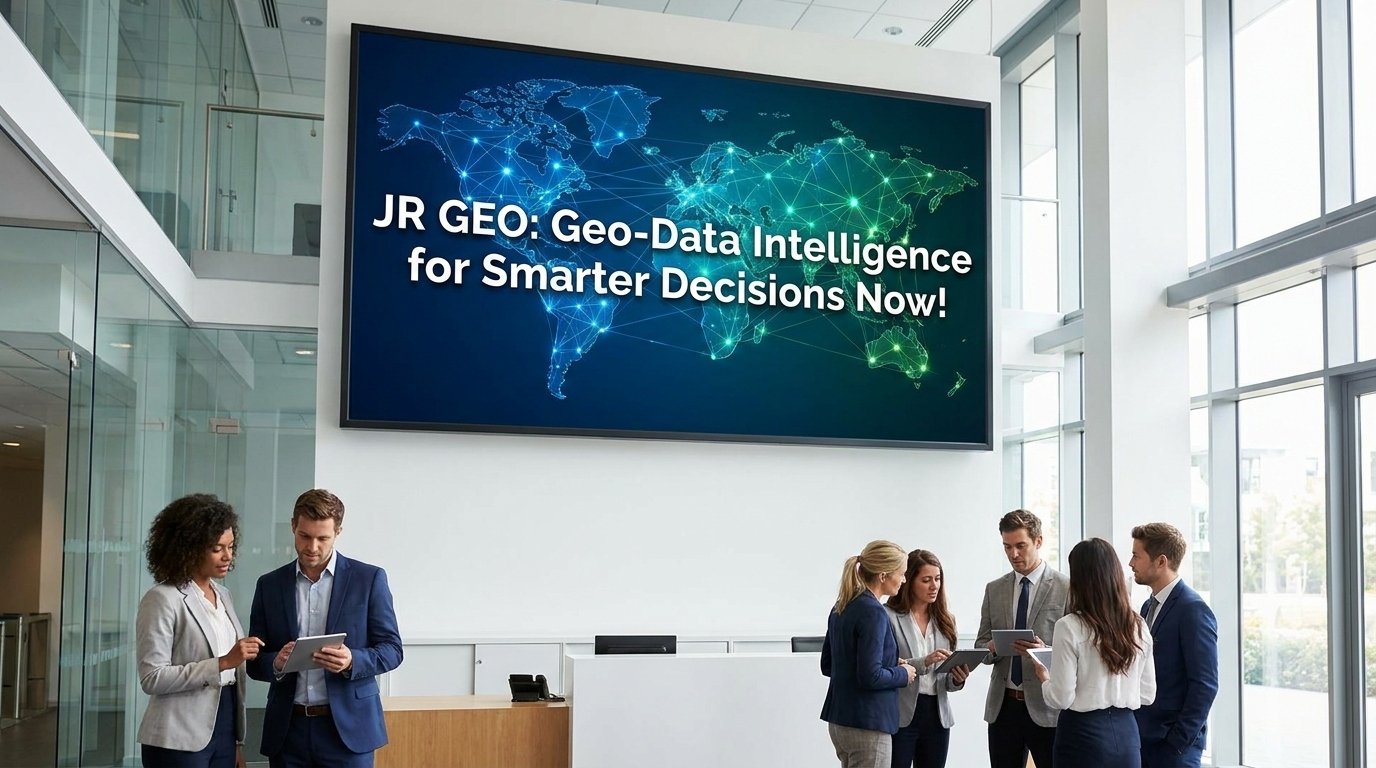
Enter JR GEO. With a clear and powerful mission, JR GEO transforms geo-data into intelligence for smarter decisions in business, automation, climate planning & global development. This is not merely a tagline; it is a foundational shift in how we perceive and utilize the geography of our world. By bridging the gap between raw coordinates and strategic insight, JR GEO is empowering sectors ranging from retail logistics to international climate policy.
This article explores how JR GEO’s unique approach to geospatial intelligence is driving a new generation of smarter, faster, and more sustainable decisions across four critical domains.
The Core Philosophy: From Data to Decision
Before diving into applications, it is essential to understand the “how.” Traditional geographic information systems (GIS) are excellent at visualization—mapping points, drawing polygons, and measuring distances. However, JR GEO moves beyond static maps. The company employs advanced machine learning, real-time data fusion, and predictive analytics to convert raw geo-data into intelligence.
Intelligence, in the JR GEO framework, is defined by three characteristics: predictive power, contextual relevance, and prescriptive action. It answers not just “where is something?” but “where will something be next week?”, “why is this pattern occurring?”, and “what should we do about it now?” This transformation is achieved through proprietary algorithms that clean, integrate, and analyze multi-source geospatial data at scale.
Read: Future with Data Science Services & Data Analytics Services
1. Smarter Decisions in Business: Location as a Strategic Asset
For businesses, location has always mattered. But JR GEO elevates location from a static attribute to a dynamic driver of competitive advantage. Retail chains, real estate developers, logistics companies, and financial institutions are using JR GEO’s intelligence to answer previously intractable questions.
Consider a national grocery chain planning new store locations. Traditional methods might look at population density and traffic counts. JR GEO, however, integrates dozens of layers: mobile device movement patterns (anonymized), competitor foot traffic, local weather trends, seasonal event data, and even social media sentiment by neighborhood. The result is a predictive heatmap not of where people are, but where they will be during key shopping hours—and what they will likely buy.
In supply chain management, JR GEO’s intelligence reduces fuel costs and delivery times by dynamically rerouting fleets based on real-time geospatial hazards—from construction zones to flash flood warnings. One logistics partner reported a 22% reduction in last-mile delays within three months of integrating JR GEO’s API. The platform does not just show traffic; it predicts congestion patterns before they form, allowing businesses to pre-position inventory.
Furthermore, insurance underwriters use JR GEO to assess property risk at an individual parcel level, combining historical wildfire boundaries, floodplain maps, and even micro-topography data. The result: more accurate premiums, fewer unexpected claims, and smarter risk portfolios. In every case, JR GEO transforms geo-data into intelligence for smarter decisions in business by making the invisible patterns of commerce visible and actionable.
2. Automation: The Nervous System of Autonomous Systems
Automation—whether in self-driving vehicles, robotic agriculture, or smart city infrastructure—depends entirely on geospatial awareness. A machine that does not know where it is, what surrounds it, and how that environment will change in the next second is blind. JR GEO provides the essential geospatial nervous system for automation.
Autonomous ground vehicles, for example, rely on high-definition maps. But static HD maps become obsolete the moment a road is repaved or a cone is moved. JR GEO offers a live-updating geospatial intelligence layer that ingests real-time inputs from thousands of sources—road sensors, other vehicles, municipal cameras—and produces a constantly refreshing semantic map. This allows automated systems to anticipate, not just react. A delivery robot powered by JR GEO does not just stop for a pedestrian; it predicts the pedestrian’s likely path based on sidewalk geometry and historical movement flows.
In industrial automation, warehouses equipped with JR GEO’s indoor positioning intelligence enable fleets of autonomous forklifts to coordinate with sub-meter precision. The system learns traffic patterns and automatically optimizes routes to prevent collisions and reduce idle time. One manufacturing client saw a 35% increase in automated guided vehicle (AGV) throughput after deploying JR GEO.
Precision agriculture is another powerful example. Autonomous tractors and harvesters use JR GEO’s layered intelligence to vary seeding rates and fertilizer application based on real-time soil moisture, nutrient maps, and micro-climate data—down to a resolution of one square meter. This is automation with intelligence, where every machine movement is guided by a deep understanding of geospatial context. Indeed, JR GEO transforms geo-data into intelligence for smarter decisions in automation, turning machines from blind executors into perceptive collaborators.
3. Climate Planning: Navigating a Changing Planet
Climate change is, at its heart, a geospatial crisis. Rising seas, shifting agricultural zones, intensifying storms, and changing fire regimes all unfold across specific coordinates. Effective climate planning requires not just global models but hyperlocal, actionable intelligence. This is where JR GEO’s capabilities become indispensable for governments, NGOs, and infrastructure planners.
Using historical climate data (temperature, precipitation, wind), current sensor networks, and predictive climate models, JR GEO generates localized risk assessments for any point on land or sea. A coastal city planning a new wastewater treatment plant can use JR GEO to see not just the current 100-year floodplain but a probabilistic forecast of flood zones in 2050 under different emission scenarios. The platform integrates IPCC AR6 data downscaled to the neighborhood level.
Beyond risk assessment, JR GEO supports active climate adaptation. In fire-prone regions, the platform analyzes real-time vegetation dryness, wind direction, lightning strike locations, and topographic slope to produce hourly wildfire likelihood maps. Emergency managers use these to pre-position resources and issue targeted evacuation orders—sometimes hours before a fire ignites. Similarly, in drought management, JR GEO combines satellite evapotranspiration data with groundwater well readings to recommend dynamic water allocation across agricultural districts.
Renewable energy planning is another focal point. Solar farm developers use JR GEO to model shading from terrain and vegetation across seasons, while wind farm operators rely on the platform’s mesoscale wind pattern predictions to optimize turbine placement. In every instance, JR GEO transforms geo-data into intelligence for smarter decisions in climate planning, enabling proactive adaptation rather than reactive disaster response.
4. Global Development: Equity, Resilience, and Sustainable Growth
Perhaps the most profound application of JR GEO’s mission lies in global development. International aid organizations, development banks, and UN agencies face immense challenges: delivering vaccines to remote villages, monitoring deforestation, mapping informal settlements, or ensuring clean water access. These challenges are fundamentally geospatial, and data scarcity has long been a barrier.
JR GEO bridges this gap by democratizing access to high-quality geospatial intelligence. Using a combination of open satellite imagery (Sentinel, Landsat), crowdsourced data, and machine learning, the platform creates detailed maps of previously unmapped regions. For example, JR GEO recently partnered with a health NGO to identify optimal locations for new clinics in rural Uganda. By analyzing travel time to existing facilities (using actual road conditions and seasonal river crossings), population density, and disease incidence data, the system recommended five sites that reduced average village travel time from 4 hours to 45 minutes.
In agriculture development, JR GEO helps smallholder farmers access crop advisory services. By integrating weather forecasts, soil maps, and pest outbreak models, the platform sends SMS-based recommendations to farmers in local languages—when to plant, when to fertilize, and when to harvest. Early results in sub-Saharan Africa showed a 28% increase in yield for participating farmers.
Disaster response is another critical arena. When a cyclone strikes a vulnerable region, JR GEO’s rapid damage assessment tool compares pre- and post-event satellite imagery using change-detection algorithms. Within hours, aid agencies receive a building-by-building damage map, prioritized by population density and accessibility. This allows scarce resources—helicopters, medical teams, food supplies—to be directed to the hardest-hit areas first.
Ultimately, JR GEO transforms geo-data into intelligence for smarter decisions in global development by ensuring that no community remains invisible to the planners and policymakers who can help them.
Integration and Ethics: The JR GEO Difference
Across all four domains—business, automation, climate planning, and global development—JR GEO distinguishes itself through two core principles: interoperability and ethical data use.
Interoperability means JR GEO’s intelligence layers are designed to work with existing tools, from ArcGIS and QGIS to custom enterprise dashboards and SCADA systems. There is no need to rip and replace. JR GEO provides REST APIs, webhook integrations, and even offline-capable mobile SDKs for field teams.
Ethical data use is equally paramount. JR GEO anonymizes all personal location data by default, using aggregation and differential privacy techniques. The company adheres to the Location Privacy Protection Guidelines and does not sell raw data to third parties. Moreover, in global development contexts, JR GEO prioritizes open data sharing with local governments and communities, ensuring that intelligence generation is a participatory process, not a colonial extraction.
The Future: Real-Time, Predictive, Planetary
Looking ahead, JR GEO is investing heavily in real-time edge processing and generative geospatial models. The next generation of the platform will allow a drone flying over a forest fire to process JR GEO’s intelligence on-board, adjusting its flight path instantly without waiting for cloud uploads. Similarly, generative models will be able to simulate thousands of “what if” scenarios—for example, “What if we build this seawall? How does that change flood risk for 50,000 properties?”
The ultimate vision is a planetary nervous system: a continuously updated, globally accessible layer of geospatial intelligence that empowers any decision-maker, anywhere, to act with clarity and confidence. That vision is embodied in the daily work of JR GEO.
Conclusion
In a world of accelerating complexity and uncertainty, static maps are no longer enough. We need intelligence that breathes, learns, and predicts. We need a partner that understands that behind every coordinate is a business decision, an automated process, a climate adaptation, or a human life.
JR GEO transforms geo-data into intelligence for smarter decisions in business, automation, climate planning & global development. Whether it is helping a retailer avoid a supply chain breakdown, guiding an autonomous tractor through a field, alerting a coastal city to rising seas, or bringing healthcare to an isolated village, JR GEO is doing the essential work of turning where into why, and why into action.