Introduction: The Imperative for High-Density 100G
The modern data center is an ecosystem under constant pressure, driven by the relentless growth of cloud services, real-time analytics, artificial intelligence, and hyper-scale virtualization. This evolution has rendered 10G and even 40G infrastructures insufficient for spine-leaf architectures and high-performance computing clusters. The industry’s answer has been the widespread adoption of 100 Gigabit Ethernet. Among the plethora of 100G transceiver options, the 100GBASE-SR4 QSFP28 has established itself as the undisputed workhorse for short-reach, high-density interconnects, forming the critical backbone for traffic within and between server racks.
Technical Architecture and Operational Principles
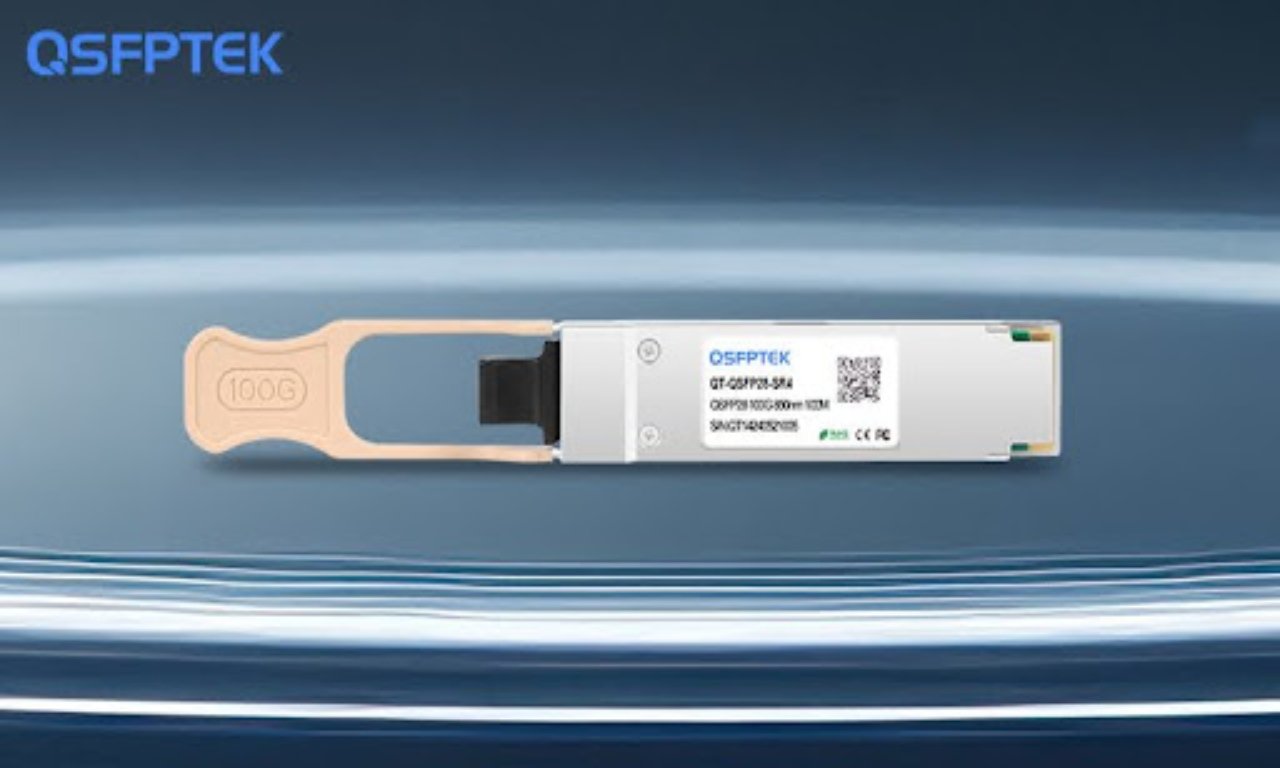
The 100GBASE-SR4 QSFP28 module is a marvel of parallel optics engineering. Its nomenclature reveals its core characteristics: “SR4” stands for Short Reach 4-lane, and “QSFP28” denotes the Quad Small Form-factor Pluggable 28 Gbps form factor. Unlike serial transmission, this module employs a parallel optical design. It multiplexes four independent electrical lanes, each carrying 25 Gbps of data (using NRZ modulation), into four corresponding optical lanes. This requires an MPO-12/MTP® connector interface, which utilizes 8 of its 12 fibers—four dedicated for transmission (Tx) and four for reception (Rx)—to achieve the full 100 Gbps duplex bandwidth.
The module is designed exclusively for use with laser-optimized multimode fiber (MMF), specifically OM3 and OM4 grades. Over OM3 fiber (50/125 µm), it supports link lengths up to 70 meters, while over higher-bandwidth OM4 fiber, this range extends to 100 meters. The latest generation, sometimes referred to as 100GBASE-SR4.2 or leveraging OM5 (wideband multimode fiber), can potentially reach 150 meters by using shortwave wavelength division multiplexing (SWDM) techniques over the same fiber count, though the classic SR4 remains dominant.
Key Advantages Driving Adoption
Unmatched Port Density and Scalability: The QSFP28 form factor packs 100G capability into the same physical dimensions as the earlier 40G QSFP+. This allows network operators to achieve a 2.5x increase in bandwidth per rack unit without changing switch hardware designs drastically. A single 32-port QSFP28 switch leaf can provide up to 3.2 Tbps of bisectional bandwidth.
Cost-Effectiveness and Power Efficiency: Leveraging VCSEL (Vertical-Cavity Surface-Emitting Laser) technology, SR4 modules are significantly more cost-effective to manufacture than their long-range single-mode counterparts. Their typical power consumption is under 3.5 watts, which is crucial for managing thermal budgets in densely packed switches, leading to lower operational expenditures (OPEX) for power and cooling.
Flexibility in Deployment: Beyond simple point-to-point links, the SR4 architecture enables powerful breakout connectivity. A single 100GBASE-SR4 QSFP28 port can be connected via an MPO-to-4xLC duplex fanout cable (or cassette) to four 25GBASE-SR SFP28 ports. This allows for efficient aggregation of four 25G servers into one 100G switch uplink, or for gracefully migrating a 40G (4x10G) breakout infrastructure to 100G/25G.
Primary Applications in the Data Center
Top-of-Rack (ToR) to Server Connectivity: In high-performance computing and storage clusters, servers equipped with 25G NICs are aggregated via breakout cables to a 100G SR4 uplink on the ToR switch.
Intra-Fabric Spine-Leaf Connections: For leaf switches connecting to the spine layer within the same or adjacent racks (within 100m), SR4 provides the most economical and dense 100G solution.
Data Center Interconnect (DCI) within a Hall: Connecting equipment across different rows or aisles within a single data center hall.
High-Speed Storage Area Networks (SAN): Supporting protocols like Fibre Channel over Ethernet (FCoE) for fast access to storage arrays.
Conclusion and Future Outlook
The 100G QSFP28 SR4 module is more than just a component; it is a foundational technology that enabled the practical and economic feasibility of 100G networks in the data center. Its combination of density, low cost, and low power has cemented its role in short-reach applications. While 400G and beyond are on the horizon, the massive installed base of OM3/OM4 fiber and the ongoing need for cost-effective server aggregation ensure that 100G SR4 will remain a critical part of the data center connectivity landscape for years to come. It represents a mature, reliable, and optimized solution for a clearly defined and essential segment of the network architecture.