Custom brewery tanks are at the heart of modern craft brewing. While standard, off-the-shelf tanks may work for some breweries, many operations eventually reach a point where custom tank solutions are the only practical way to improve efficiency, product quality, and scalability. Ceiling height limits, unique beer styles, expansion plans, utility constraints, and workflow preferences often require tanks that are designed specifically for a brewery’s needs.
This article provides a full walkthrough of a custom brewery tank project, following a realistic brewery scenario from the initial idea to final commissioning. Along the way, we’ll explain key decisions, common challenges, timelines, and best practices—so you can better understand what goes into a custom tank project and how to manage one successfully.Craft Brewing Equipment Manufacturers
Project Background: Why the Brewery Needed Custom Tanks
Let’s start with a realistic scenario.
A regional craft brewery had been operating successfully for several years with a standard 10 BBL system and a mix of off-the-shelf fermenters. As demand grew, the brewery faced several challenges:
Fermentation capacity was limiting production
Tank heights did not fully utilize available ceiling space
Certain beer styles (high-gravity ales and fruit beers) required more headspace and specialized fittings
Cleaning and turnaround times were becoming inefficient
Expansion space existed, but standard tanks didn’t fit the layout
Rather than replacing everything with larger standard tanks, the brewery decided to invest in a custom brewery tank project designed around its specific building, brewing process, and growth plan.
Phase One: Defining Requirements and Objectives
Every successful custom tank project starts with clear requirements. Before contacting manufacturers, the brewery team defined their goals.
Key Questions Asked Internally
What is our target batch size for the next 5–10 years?
How many fermenters and brite tanks do we need?
Which beer styles drive our production volume?
Are we prioritizing faster tank turns or longer conditioning?
What are our physical constraints (ceiling height, floor load, door width)?
How will these tanks integrate with existing utilities?
Finalized Project Goals
Add four custom 30 BBL fermenters and two 30 BBL brite tanks
Maximize vertical space without exceeding ceiling limits
Improve CIP efficiency and reduce cleaning time
Support high-pressure fermentation and in-tank carbonation
Prepare the cellar for future automation upgrades
Having these goals documented made communication with equipment manufacturers far more effective.
Phase Two: Site Evaluation and Layout Planning
Custom tanks must fit the brewery—not the other way around.
On-Site Measurements
The brewery carefully measured:
Clear ceiling height (including lighting, ductwork, and sprinklers)
Floor slope and drain placement
Column spacing and aisle widths
Door dimensions for tank delivery
Utility access points (glycol, water, compressed air, CO₂)
These measurements were shared with the manufacturer to avoid costly surprises later.
Layout Optimization
Working with CAD drawings, the team evaluated:
Tank spacing for safe access and cleaning
Hose routing and transfer paths
Forklift and pallet movement
Future expansion zones
Custom tank diameter and cone angles were adjusted to maximize volume while preserving safe working clearances.
Phase Three: Custom Tank Design & Engineering
This is where custom projects differ most from standard purchases.
Tank Design Decisions
Tank height and diameter
Taller tanks allowed more volume without increasing footprint
Diameter was limited by door access and aisle clearance
Cone angle
Steeper cones for improved yeast harvesting
Optimized racking arm performance
Pressure rating
Designed for higher pressure to support spunding and carbonation
Included certified pressure relief and vacuum valves
Jackets and insulation
Multi-zone glycol jackets for precise temperature control
Full polyurethane insulation to reduce energy use
Ports and fittings
Extra tri-clamp ports for fruit additions and dry hopping
Dedicated CIP return ports
Sample valves positioned for safe access
Large manways for inspection and manual adjunct additions
Engineering Review
Before fabrication began:
Detailed drawings were reviewed line by line
Weld standards and surface finishes were confirmed
Utility connections were matched to existing systems
Any changes were finalized to avoid delays
This step is critical—late design changes are one of the biggest causes of extended lead times.
Phase Four: Fabrication of Custom Brewery Tanks
Once designs were approved, fabrication began.
Material Preparation
Food-grade stainless steel sheets were cut and rolled
Cones and shells were formed to precise tolerances
Fittings and ferrules were prepared for welding
Welding & Assembly
Internal and external welds were performed by skilled fabricators
Welds were ground and polished to sanitary standards
Jackets were pressure-tested before insulation
Quality Control
Throughout fabrication:
Welds were visually inspected
Dimensional checks ensured exact height and diameter
Pressure tests verified tank integrity
Surface finish inspections ensured cleanability
Photos and progress updates were shared with the brewery to maintain transparency.
Phase Five: Testing, Finishing, and Pre-Shipment Preparation
Before shipping, each custom tank underwent final checks.
Testing Procedures
Hydrostatic pressure testing
Jacket leak testing
Valve and fitting verification
Accessory installation (spray balls, racking arms, sensors)
Finishing
Exterior cladding installed
Insulation sealed
Nameplates and documentation prepared
Tanks cleaned and dried for transport
At this stage, the tanks were effectively production-ready.
Phase Six: Shipping and Delivery Planning
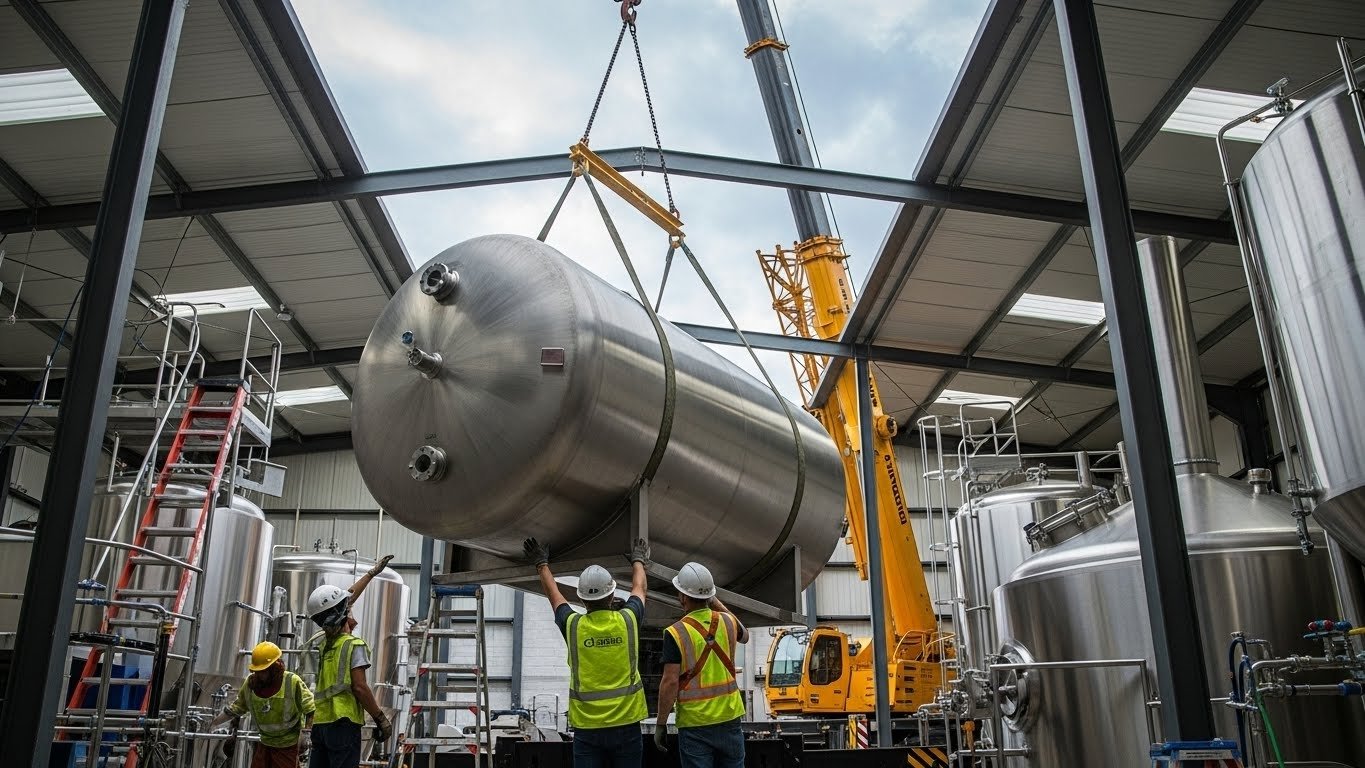
Custom brewery tanks are large, heavy, and delicate.
Logistics Considerations
Oversized freight planning
Protective crating and padding
Delivery route verification
Coordination with brewery staff and contractors
The brewery ensured:
A forklift and rigging crew were scheduled
Floor protection was installed
Doorways were cleared and measured again
Proper planning prevented damage and delays during unloading.
Phase Seven: Installation and Utility Connections
Once delivered, installation began immediately.
Tank Positioning
Tanks were set according to layout drawings
Leveling was carefully adjusted for proper drainage
Clearances were checked for safety and compliance
Utility Hookups
Glycol lines connected and insulated
CIP lines integrated into existing system
CO₂ and compressed air connected
Sensors and gauges wired to control panels
Because the tanks were custom-designed for the space, installation proceeded smoothly without rework.
Phase Eight: Commissioning and First Use
Commissioning is the final step before brewing.
Commissioning Checklist
Pressure testing on-site
Glycol flow verification
Temperature control calibration
CIP cycle testing
Valve and PRV checks
First Cleaning Cycle
Before beer entered the tanks:
Full CIP cycles were run
Flow patterns were observed
Spray ball coverage was confirmed
First Fermentation
The brewery chose a familiar flagship beer for the first fill to:
Validate fermentation performance
Monitor temperature stability
Evaluate yeast harvesting
Check carbonation capability
Results showed improved consistency and reduced turnaround time compared to the old tanks.
Project Results: What the Brewery Achieved
After the custom tank project was completed, the brewery saw measurable benefits:
Operational Improvements
Increased fermentation capacity without expanding footprint
Faster cleaning and turnaround times
Improved temperature stability
Better yeast management
Financial Impact
Higher throughput without increasing brew days
Lower energy usage due to improved insulation
Reduced need for temporary tanks or contract brewing
Long-Term Flexibility
Tanks designed to support new beer styles
Ports available for future automation upgrades
Layout ready for additional expansion
Lessons Learned from the Custom Tank Project
This walkthrough highlights several key lessons:
Define requirements early
Clear goals prevent costly redesigns.
Measure everything twice
Site constraints drive custom design.
Review drawings carefully
Small details matter in daily operations.
Plan logistics in advance
Delivery and installation are as important as fabrication.
Think long-term
Custom tanks should serve future growth, not just current needs.
Conclusion: Why Micet Is a Strong Partner for Custom Brewery Tank Projects
A successful custom brewery tank project requires more than stainless steel—it requires engineering expertise, clear communication, reliable fabrication, and project coordination.
Micet is well-positioned to support breweries through custom tank projects like the one outlined above. Their strengths include:
Custom-designed fermentation and brite tanks
Strong fabrication standards and sanitary finishes
Engineering support from layout through commissioning
Clear lead time communication
Scalable solutions for growing breweries
Whether you’re expanding capacity, optimizing an existing cellar, or building a new brewery from scratch, Micet’s custom brewery tank solutions can help you achieve efficient, future-ready production with confidence.
FAQs
- How long does a custom brewery tank project usually take?
From design approval to delivery, most custom brewery tank projects take 8–16 weeks, depending on tank size, complexity, certifications, and shipping distance. Additional time is required for installation and commissioning.
- Are custom brewery tanks much more expensive than standard tanks?
Custom tanks often cost more upfront, but they frequently reduce long-term costs by improving efficiency, maximizing space, and minimizing future modifications. For many breweries, the ROI justifies the investment.
- What information should I prepare before ordering custom tanks?
You should prepare:
Target batch size and tank volume
Ceiling height and floor layout
Utility specifications
Beer styles and process requirements
Expansion plans
This information allows manufacturers to design tanks that truly fit your brewery.Taba Squishy