You might be feeling uneasy right now. Maybe your child’s orthodontist just mentioned an “impacted canine” on an X‑ray, or your own dentist pointed out that one of your eye teeth has never really come in. The word “impacted” sounds serious, and hearing that you may need an Oral Surgeon in Warren, NJ can make your mind jump straight to pain, surgery, and cost.
It often starts simply. A routine dental checkup. A panoramic X‑ray. A quiet pause from the dentist while they study the image. Then the explanation that a canine tooth is stuck in the bone and cannot erupt on its own. Suddenly you are trying to process new terms, possible surgery, and what this means for a smile you care deeply about.
If that is where you are standing right now, you are not overreacting. Impacted canines are common; they can be confusing, and they usually require careful teamwork between an orthodontist and an oral surgeon. The brief version is this. An impacted canine is a tooth that is trapped under the gums or in the jaw and cannot come into its normal position. Braces alone usually cannot fix this. An oral surgeon often needs to gently uncover the tooth and help guide it into place. When done in time and with a clear plan, treatment is usually very successful and protects your bite, your other teeth, and your confidence.
So where does that leave you now that you know a bit more about what is happening?
What does it actually mean when a canine tooth is “impacted” and why does it matter so much?
An impacted tooth has not erupted into the mouth when it should have, or cannot erupt at all because something is blocking it. The American Association of Orthodontists has a straightforward description of what an impacted tooth is and why it happens, which you can read in more detail on their site about impacted teeth and orthodontic care.
Canines are the pointed “corner” teeth toward the front of your mouth. They are key to both function and appearance. They help you tear food, guide your bite into the right position, and support the lips. Because they erupt later than the front teeth and have a long, deep root, they are more likely than many other teeth to become impacted.
So why is this such a concern? When a canine stays trapped in the bone, it can start to cause real problems over time. For example, it can push against the roots of nearby teeth and erode them. It can create crowding that braces alone cannot solve. It can even lead to cysts in the jaw. On the emotional side, a missing or high “fang” tooth can make a teenager deeply self-conscious at exactly the age when confidence is fragile.
Because of this tension between what is happening now and what could happen later, you might wonder why an orthodontist cannot just “pull it down” with braces alone.
Why is an oral surgeon usually part of treatment for impacted canines?
Orthodontists are experts at moving teeth that are in the mouth. An oral surgeon and implant dentist is trained to work with teeth that are still in the bone or buried under the gums. When a canine is impacted, these two skill sets usually need to come together.
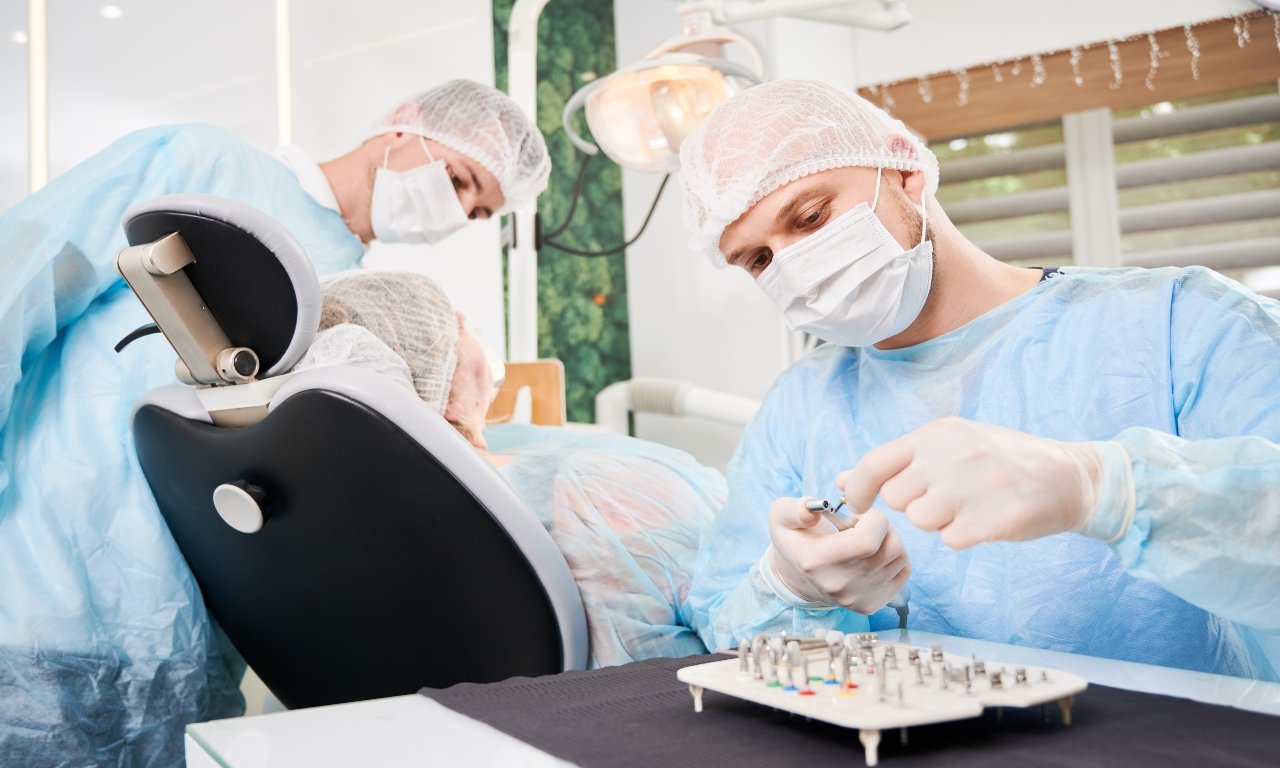
Here is how it often works. The orthodontist uses braces or aligners to create space for the canine in the dental arch. Once that space is ready, the oral surgeon performs a minor surgical procedure called “exposure and bonding.” The surgeon gently uncovers the impacted canine, either by removing a small window of gum and sometimes a bit of bone, then attaches a tiny bracket and chain or button to the tooth. After that, the orthodontist slowly guides the tooth into its correct position using gentle traction.
If you want a visual explanation of how surgeons approach impacted teeth, the description from Oral Surgery Columbia on surgical treatment of impacted teeth gives a helpful overview of what is involved.
This kind of teamwork is needed because the canine is often high in the gum, rotated, or angled in a way that makes it impossible for braces alone to capture it. The surgeon’s role is to safely access the tooth without harming roots, nerves, or gum tissue. The orthodontist’s role is to then move the tooth into its final place in a controlled way.
Without that surgical help, the tooth might stay stuck for years or never erupt at all. In some cases it can even threaten the health of nearby incisors. That is why treatment for impacted canines is usually planned early and handled with care.
What could happen if an impacted canine is ignored or handled too late?
This is often the part that keeps parents up at night. You may be wondering what is at risk if you wait, or if you try to avoid surgery altogether.
Here are a few realistic “what if” scenarios.
What if the impacted canine is pressing against the root of a front tooth and no one intervenes? Over time, that pressure can resorb the root and shorten it. In severe cases, the front tooth can become loose or be lost, which is emotionally and financially difficult to fix.
What if the tooth is sitting inside a soft tissue sac and that sac slowly enlarges? This can develop into a cyst in the jaw. Cysts can weaken bone and require more complex surgery than a simple exposure would have.
What if the orthodontist attempts to move the tooth without surgical exposure? If the tooth is completely covered by bone or gum, the forces may not reach it effectively. Treatment can drag on, costs can rise, and the tooth may still not come in correctly.
On the emotional side, a teenager who sees classmates finishing braces while they still have a missing or misaligned canine can feel left behind. That sense of “something is wrong with me” is hard to measure but very real.
The good news is that when the problem is recognized early, and an experienced oral surgeon is involved, the process is usually straightforward and outcomes are strong. The British Association of Oral and Maxillofacial Surgeons offers a clear patient guide on exposure of an impacted canine and what to expect, which can ease some of the uncertainty.
Comparing your options for impacted canine treatment
You may be weighing your choices. Do you proceed with surgery now? Do you wait and watch? Do you remove the tooth and replace it later? The table below outlines common paths and what they usually mean in real life.
| Approach | What it involves | Typical benefits | Typical risks or downsides | Best suited for |
|---|---|---|---|---|
| Early exposure with orthodontic traction | Oral surgeon uncovers the tooth and bonds a bracket. Orthodontist guides tooth into place. | Preserves natural tooth. Supports a stable bite and appearance. High success rate when done early. | Requires surgery and orthodontic treatment. Some discomfort and healing time. | Most children and teens with impacted canines that have a reasonable path into the arch. |
| Watchful waiting with monitoring | Regular X‑rays and exams to see if the tooth erupts or moves on its own. | No immediate surgery. Allows natural eruption if it is likely. | Risk of delayed treatment. Possible damage to nearby roots or cyst formation if issues progress. | Younger patients where eruption is still possible, and the tooth is not threatening other roots. |
| Extraction and later replacement | Removal of the impacted canine. Space later restored with orthodontics, a bridge, or an implant. | Removes a tooth that is badly positioned or causing damage. Can simplify orthodontic plan. | Loses the natural canine. Later cost for replacement such as an implant or bridge. Longer overall timeline. | Cases where the canine is too high, fused, or severely off course, or in adults where movement is unlikely. |
Seeing these options side by side can clarify why an experienced oral surgeon for impacted canine treatment is so often recommended. The goal is always to protect your long-term oral health while respecting your time, your comfort, and your budget.
Three steps you can take right now to move from worry to a clear plan
Once you understand the basics, the next question is simple. What should you actually do next?
- Ask for a clear explanation of the X‑rays and the tooth’s position
Request that your dentist or orthodontist walk you through the images in plain language. Ask where the impacted canine is located, how close it is to the roots of nearby teeth, and whether it appears favorably positioned for guided eruption. Take notes. If you feel rushed or confused, say so. You are entitled to understand what is going on in your own or your child’s mouth.
- Schedule a consultation with an oral surgeon and bring your questions
An oral surgeon can review the imaging, examine the mouth, and explain the specific procedure recommended. Ask about the type of anesthesia, the length of the surgery, expected pain levels afterward, time off school or work, and how long the orthodontic part might take. A good surgeon will welcome these questions and discuss realistic outcomes, not just best-case scenarios.
- Plan the timing and support around treatment
Once you decide on a path, plan ahead. Choose a surgery date that allows a quiet day or two afterward. Arrange school notes or time off work if needed. Stock soft foods and any recommended over-the-counter pain relief. If your child is the patient, talk about what will happen in simple, reassuring terms. Knowing what to expect can lower anxiety for everyone involved.
Finding steady ground when you are facing impacted canine surgery
Hearing that you or your child needs help for an impacted canine can feel heavy at first. It changes a simple orthodontic story into something that involves surgery, healing, and more appointments. That reaction is human. It is allowed.
With the right team, though, this does not have to define you or your child. An experienced oral surgeon working closely with an orthodontist can usually bring the tooth into place, protect the nearby teeth, and support a strong, confident smile. Your role is to ask questions, understand your options, and choose the path that fits your situation and values.
You do not have to have every answer today. You just need the next step, and then the one after that. Over time, those small decisions add up to a healthy mouth and a story that moves from fear to relief.